
Just Walk It Off
"Walk it off" means to walk around to alleviate minor physical or emotional pain. It's often used to suggest that someone can feel better by simply moving or taking a break.
Context
Jonathan Alpert, a DC and NYC-based psychotherapist, recently wrote regarding one of the most salient manifestations of the ongoing high level of anxiety and depression[1] within the US population:
“Is “Trump derangement syndrome” real? No serious mental-health professional would render such a partisan and derogatory diagnosis. Yet I’ve seen it in my own psychotherapy practice. Patients across the political spectrum have brought Donald Trump into therapy not to discuss policy but to process obsession, rage and dread. Their distress is symptomatic, not ideological. Clinically, the presentation aligns with anxiety and obsessive-compulsive disorders: persistent intrusive thoughts, emotional dysregulation and impaired functioning. Patients describe sleepless nights, compulsive news checking and physical agitation. Many confess they can’t stop thinking about Donald Trump even when they try. They interpret his every move as a threat to democracy and to their own safety and control.
… The clinical importance of distinguishing this pattern lies in treatment. When it is coded simply as generalized anxiety or OCD [obsessive compulsive disorder], patients often receive reassurance or validation that briefly soothes them but ultimately reinforces the fixation. In this presentation, anxiety has fused with identity. The therapeutic work is to help patients regain psychological distance so they can separate internal fears from the political figure onto whom they have projected them. That requires limiting compulsive information seeking and disrupting the social feedback loops that sustain the preoccupation, rather than merely reducing anxiety.”
According to the American Psychiatric Association, “…anxiety disorders are a group of mental disorders characterized by significant and uncontrollable feelings of anxiety and fear such that a person’s social, occupational, and personal functions are significantly impaired. Anxiety may cause physical and cognitive symptoms, such as a sense of impending doom, restlessness, irritability, easy fatigue, difficulty concentrating, increased heart rate, chest pain, abdominal pain, and a variety of other symptoms that vary based on the individual.”
Depression, anxiety’s extremely frequent co-morbidity, is a mental state of low mood and aversion to activity. People with depression experience sadness, feelings of dejection or despair, difficulty in thinking and concentration, hypersomnia or insomnia, overeating or anorexia, or suicidal thoughts.
Depression and anxiety are linked bi-directionally and causally in adults of both sexes. The evidence shows that each condition increases the risk of developing the other, rather than one simply being a symptom or correlate of the other. This relationship holds across the sexes, although adult women experience higher overall anxiety/depression prevalence and co-morbidity rates (about 1.5–2 times higher than men for both anxiety and depression).
Fortunately, accumulated scientific evidence indicates that physical activity is at least as effective as psychological and pharmacological treatments for depression and anxiety. This is yet another finding consistent with evolutionary discordance theory.
Walking (or Dancing) It Off
So, rather than taking the time and expense to visit a psychotherapist, it turns out that engaging in already health-conferring physical activities like walking very significantly disrupt fixations, preoccupations, and the reinforcing social feedback loops that generate and maintain anxiety and its sibling, depression.
Here are several of the more notable research summaries on the subject:
A 2024 systematic review of 75 randomized controlled trials (RCTs) involving over 8,600 adults found that various forms of walking (e.g., indoor/outdoor, group/individual) significantly reduced depressive symptoms (standardized mean difference [SMD] -0.591)[2] and anxiety symptoms (SMD -0.446) compared to inactive controls, with effects comparable to other active physical and mental activities like yoga or strength training.
According to this study, people with pre-existing depression benefited even more (SMD -1.863) from walking.
Walking also possesses a dose effect where the farther a person walks, the greater the mental benefit they receive. For example, starting with 1,000 daily steps correlates to a 10% drop in depression risk, peaking at over 7,500 steps for up to 42% reduction.
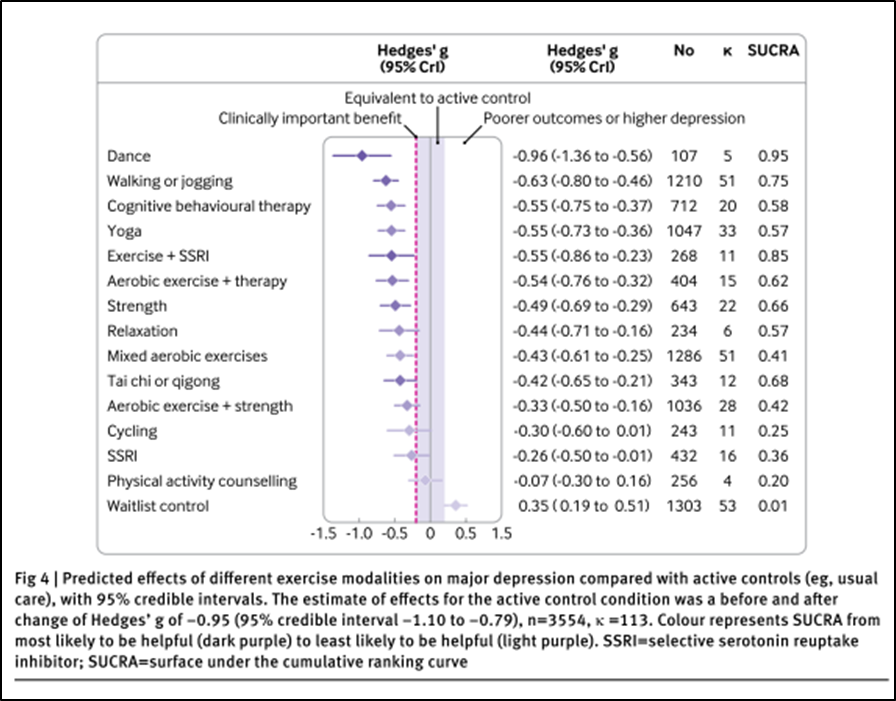
Moreover, other studies indicate that some forms of exercise are substantially more beneficial with regard to reversible mental ailments like depression than others. As an example, see the graph below taken from one such research effort. This study showed that all physical exercises provide more mental and emotional benefit than the use of prescribed anti-depressants like SSRIs. Walking was second only to dance in reducing the feelings of depression.
A Final Observation
It was earlier remarked that women are particularly prone to anxiety and depression. This basic fact may, in fact, underlie and explain much of the current general state of discontent and agitation expressed in the aggregate by the female-dominant US Democrat political party. Fortunately, research (including that cited above) consistently also shows that women mentally and emotionally benefit much more strongly from physical activity than do men. Potentially this gives the historically more common courtship activities of dancing and going for walks more than random, incidental significance.
[1] The standardized mean difference (SMD) quantifies the difference between two group means in terms of standard deviations, allowing for comparison across different studies or variables. An SMD of 0 indicates no difference, while values greater than 0 correspond to a positive difference, and values less than 0 indicate a negative difference. Larger absolute values represent a greater effect size.
[2] Approximately 19.1% of U.S. adults experience any clinical grade anxiety disorder (e.g., generalized anxiety disorder [GAD], panic disorder, social anxiety) in a given year. Women are about 1.7-1.8 times more likely than men to do so. Approximately 8.3% of U.S. adults experience a major depressive disorder in a given year. This weighted average breaks down to 10.3% for women and 6.2% for men.
Brilliant frame, and a wonderfully ancient solution. It is shocking how few people realize reality does not exist in their glowing screens or in what those screens tell them about reality.